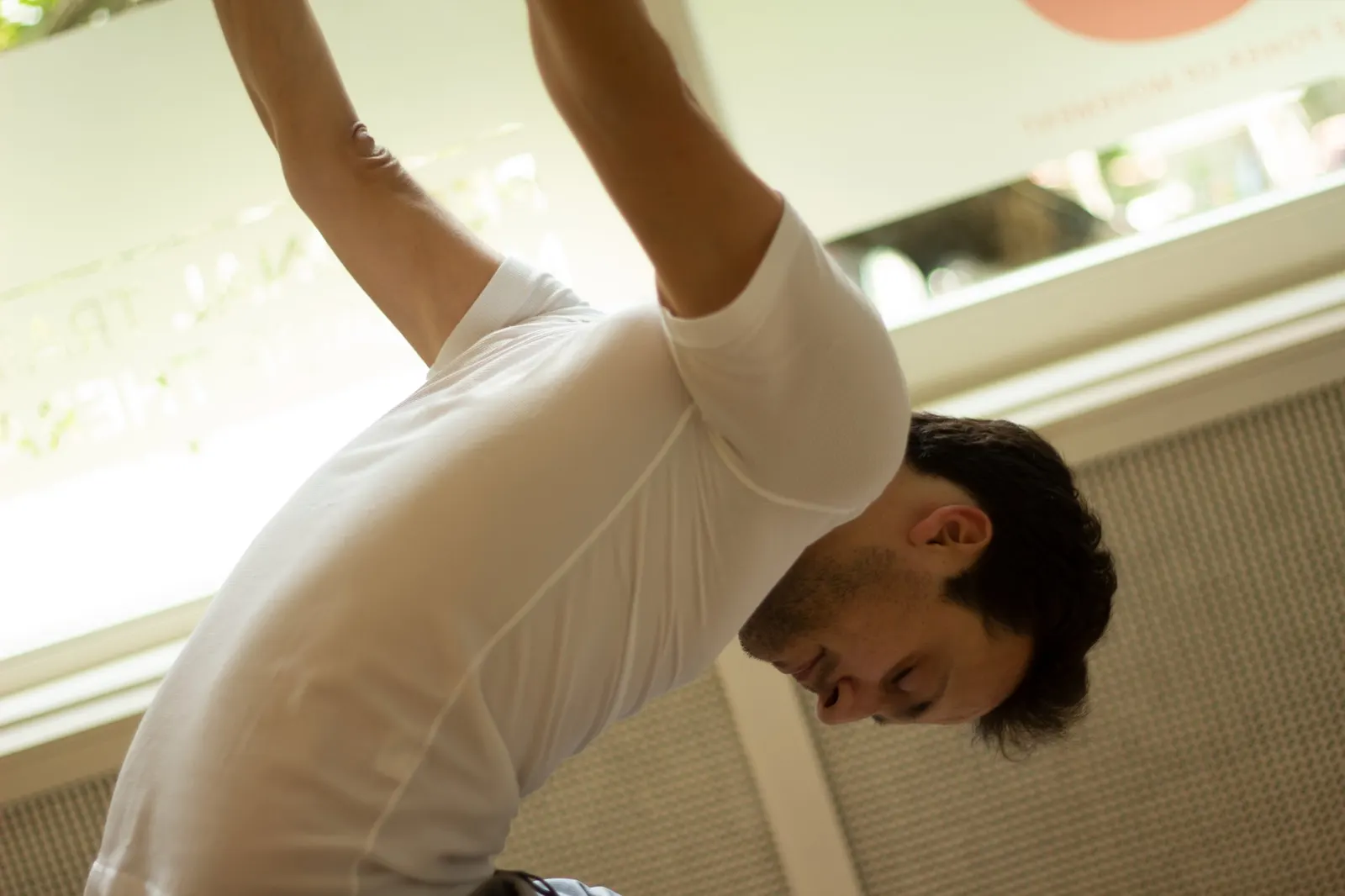
"Is GYROTONIC® like Pilates?" It is the question I am asked most. It makes sense: when we do not know something, we try to place it in a family we already know. And in a way they do belong to the same family, because both work the body consciously.
But once you look into the methodology, you see that the GYROTONIC® method was born and developed along a completely different path. How it is taught changes, how the exercises are done changes and, above all, how they feel in the body changes. Here are the differences, from my experience as a dancer and as a GYROKINESIS® Master Trainer.
How they are alike
Both methods aim for a stronger, more mobile and more aware body. In both you work with attention to the centre of the body and to the quality of movement, and both use specific equipment. That is where the similarities end.
A different origin
Pilates was created by Joseph Pilates in the early 20th century as a physical conditioning system. The GYROTONIC® method was created by Juliu Horvath, a Romanian-born dancer who became a principal dancer with Houston Ballet. A ruptured Achilles tendon ended his career.
Juliu needed to heal, and he used everything he knew to do it: dance, yoga, swimming and tai chi. He spent six years in retreat in the Virgin Islands, studying yoga and meditation. From there came first what is today the GYROKINESIS® method, practised without equipment, and later the GYROTONIC® method, with its pulley and wheel equipment.
In other words, it was not born as an exercise system, but as a dancer’s path to recovering from his injuries.
Three-dimensional, not linear
This is the first big difference. Pilates was born as a system of mainly linear movements: flexing, extending, lifting, lowering. The GYROTONIC® method was born as a holistic system of three-dimensional movements: spirals, waves and circles that involve the whole body at every moment.
You do not work one isolated muscle, but the whole chain: the spine, the joints and the breath move together, as in dance.
Stabilization through contrast
One of the method’s own principles is to always look for opposing forces. While one part of the body lengthens in one direction, another anchors or lengthens in the opposite one. Stability comes from that contrast.
Add to this the idea of spreading the effort evenly throughout the whole movement, the equal distribution of forces. Thanks to it, the joints expand and keep their range of motion without compression. These concepts are unique to the GYROTONIC® method, and they are why it is taught, performed and felt so differently from Pilates.
The breath
In the GYROTONIC® method, breathing is a very specific practice. There are many types of breath: sometimes they adapt to the movement, and sometimes the movement adapts to the breath. It is almost a dance between the two.
That dialogue stimulates the nervous system and the body’s energy. Everything starts from what we call the seed center, so that this energy spreads along the whole spine and through the whole body.
“For everybody, the breath is your life force.”
— Juliu Horvath
Beyond the body
Being a holistic practice, the method takes every aspect of the body into account: physical, structural and biomechanical, but also energetic. When you practise it over time, the GYROKINESIS® and GYROTONIC® methods also become energy work that takes your body awareness beyond your physical structure.
For me it is also spiritual work: connecting with the sky while rooting yourself in the earth. Embracing the earth and observing your own being in it.
The best way to understand it is to try it. Come and try a private session in Madrid, at C/ Serrano 6 or C/ General Arrando 6: book your class.
Want to feel the difference?
Book a private GYROTONIC® session in Madrid, at C/ Serrano 6 or C/ General Arrando 6.
